

This guide explains Horse Championship with practical details and clear takeaways. Alexander Kostritsyn delivered a memorable performance by capturing his first World Series of Poker bracelet in Event #97, the $25,000 H.O.R.S.E. Championship. The win marked a major milestone in his poker career. He beat an elite field to claim one of the schedule’s most respected titles. For background on the live series, see the 2026 WSOP live blog updates from PokerNews.
As a result, the $25,000 H.O.R.S.E. event is a real test of all-around poker skill. Unlike single-game tournaments, H.O.R.S.E. rotates through five variants: Hold’em, Omaha Hi-Lo, Razz, Seven Card Stud, and Seven Card Stud Hi-Lo. Players must adjust quickly and avoid relying on one format. That makes the event a challenge of skill, patience, and stamina.
HORSE Championship and a breakthrough win
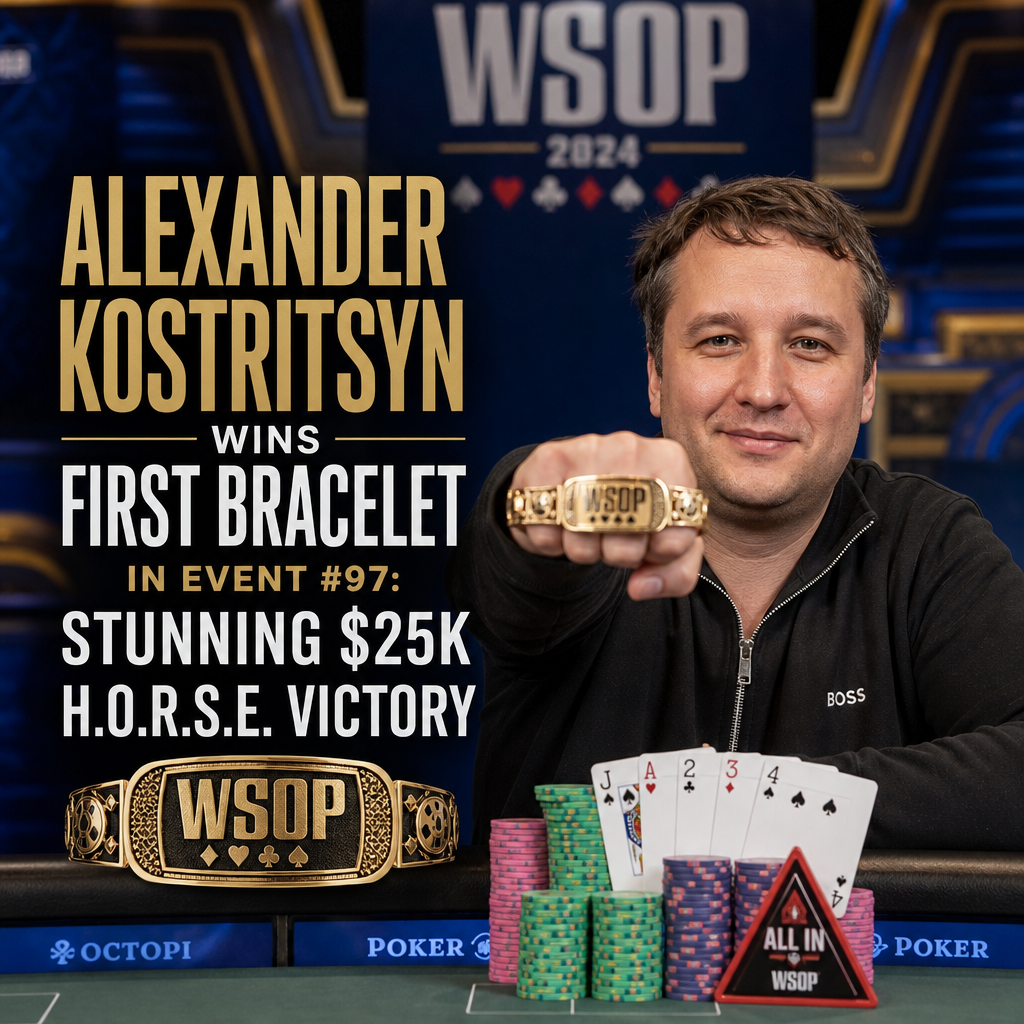
However, the importance of Kostritsyn’s victory goes beyond the bracelet and prize money. Mixed-game titles at the $25,000 level usually draw some of the world’s best players. As a result, luck alone rarely carries anyone to the finish. Every variant creates a new problem, and a player must solve all five to win.
For example, Kostritsyn handled that challenge well. Some players build momentum in one or two games, but H.O.R.S.E. tests consistency across the full rotation. A strong hold’em player can fall behind in stud. Likewise, a Razz specialist may gain ground, then lose it in Omaha Hi-Lo. Kostritsyn stayed balanced in every round and kept his edge through the event.
HORSE Championship against an elite field
High-roller mixed-game events attract a small but very tough field. The $25,000 buy-in filters out casual entries and leaves only serious contenders. That often leads to dramatic final tables, where every decision matters and small mistakes get punished fast.
Meanwhile, Kostritsyn’s route to the title took more than technical skill. It also required resilience. In this kind of event, swings can be harsh. A player may lose a big pot in one game and then face a new puzzle a few hands later. To win, he had to stay calm and focus on long-term value.
Table awareness also matters in mixed games. Many opponents are well-known specialists, so reading tendencies becomes important. One player may attack in stud but slow down in Omaha Hi-Lo. Another may gamble in hold’em but tighten up in Razz. Spotting those patterns can make the difference between a deep run and a final-table exit.
Why H.O.R.S.E. is so respected
Overall, H.O.R.S.E. feels like a purer test than no-limit hold’em alone. The format rewards broad poker knowledge, not just one style. Since the games rotate, players must think differently every orbit. That also exposes weak spots very quickly.
In addition, Hold’em rewards familiar betting and pressure. Omaha Hi-Lo adds split-pot complexity and careful hand selection. Razz flips hand strength on its head and demands sharp board reading. Seven Card Stud puts a premium on memory and exposed-card tracking. Seven Card Stud Hi-Lo combines those ideas with split-pot strategy.
That is why a bracelet in this event carries so much respect. It shows both depth and range. Kostritsyn’s victory fits that standard.
A career-defining moment
Winning a first bracelet is a major milestone for any professional. It rewards years of study, travel, and competition. In Kostritsyn’s case, the achievement stands out even more because it came in such a demanding event.
Many players spend years chasing a bracelet. They wait for the right mix of form, field, and run good. When the breakthrough finally comes, it often feels like relief as much as celebration. Kostritsyn likely felt that pressure lift after such a hard-fought win.
The bracelet also strengthens his place in the poker world. Mixed-game players already earn respect for discipline and depth. A win in a marquee event like this raises that standing even further. It shows he can beat the best in a format with very little room for error.
What the victory says about his game
However, Kostritsyn’s result points to strong preparation and sharp instincts. Mixed games reward players who can spot which opponents are strongest in each variant. They must then use that information to build small edges over time. That takes more than charts. It takes live-game feel, patience, and quick adjustments.
The win also highlights his discipline. In a H.O.R.S.E. championship, there are often long stretches where no one can force action. The best players accept that pace and keep making sound decisions. Kostritsyn’s finish suggests he handled those stretches well and struck at the right moments.
The legacy of Event #97
Event #97 will be remembered as the tournament where Alexander Kostritsyn won his first bracelet. It also adds another strong chapter to high-stakes mixed-game history. Every year, the $25,000 H.O.R.S.E. event produces stories of endurance, skill, and sharp poker thinking. Kostritsyn’s run fits that tradition.
For mixed-game fans, the result is another reminder of why the format matters. It rewards versatility and punishes complacency. Most of all, it crowns players who understand poker across many forms. Kostritsyn proved he belongs in that group.
Meanwhile, for another example of a recent mixed-game result, read about mafbet poker.
Overall, this victory makes Alexander Kostritsyn one of the select players who have conquered one of poker’s most respected championships. The win is more than a statistic. It is a defining moment that reflects his talent and his ability to rise when the stakes are highest.