

In addition, the poker shot clock at the WSOP Main Event has become one of the most debated tools in modern tournament poker. For some players and fans, it keeps the game fair, watchable, and efficient. For others, it adds pressure at the biggest moments in poker. The debate is easy to understand. The WSOP Main Event should test skill, endurance, and composure, but a shot clock also changes the rhythm of decision-making at the table. For background on the event itself, see the PokerNews podcast discussion of the WSOP shot clock.
As a result, a related perspective on how tournament formats can shape outcomes is covered in WSOP Main Event Shot Clock: Fair or Best for Players?
What the Poker Shot Clock Actually Does
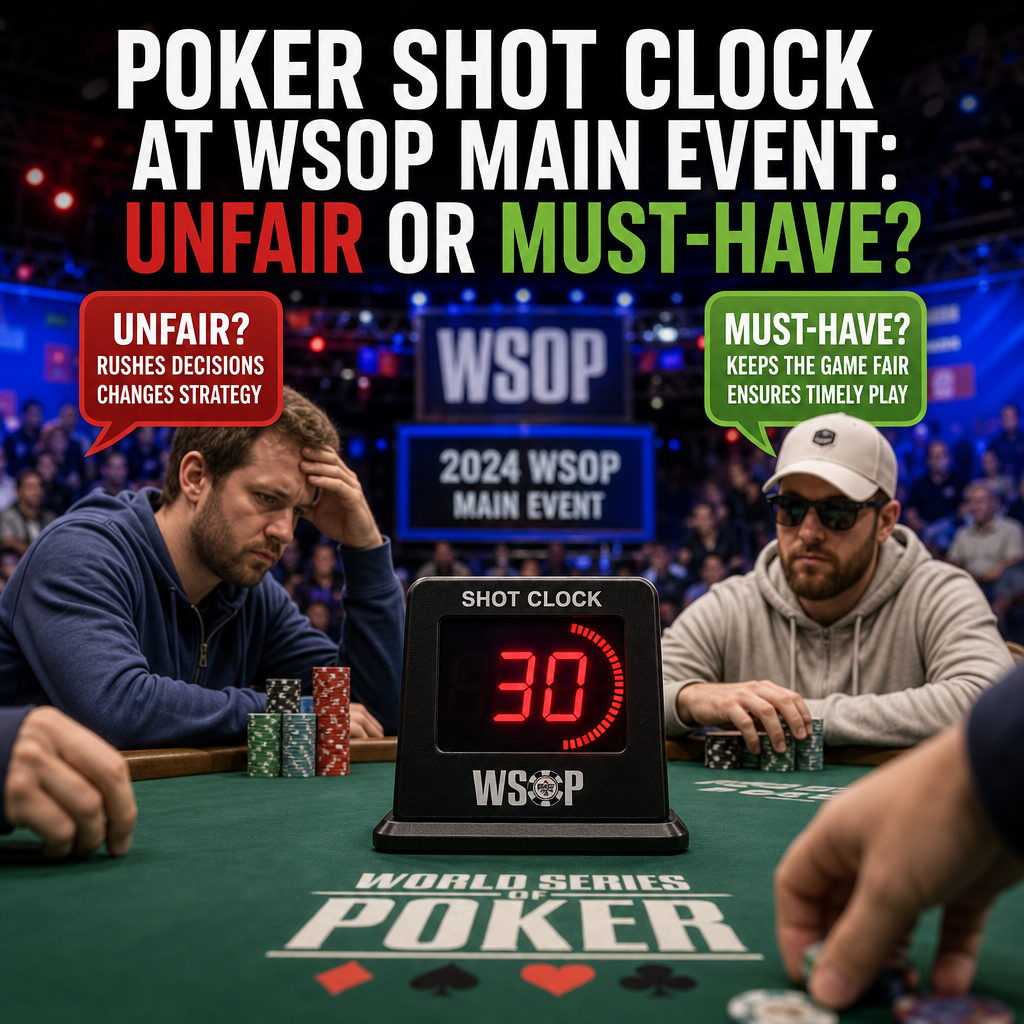
As a result, a poker shot clock is a countdown timer that limits how long a player has to act. In live tournament poker, organizers use it to prevent excessive tanking. That usually means a player spends too long on a routine move. In the WSOP Main Event, the clock often works with time bank cards. Those cards give players a few extra moments for difficult spots.
However, the basic idea is simple. Every player gets a fair chance to think, but no one can stall the game indefinitely. As a result, the table keeps a steadier pace. It also reduces situations where one player slows the entire table for everyone else.
Why Supporters Say the Poker Shot Clock Is Necessary
For example, Many players and spectators believe the shot clock is essential in a modern major tournament. Their argument usually comes down to fairness, integrity, and flow.
Poker Shot Clock and it prevents stalling and angle-shooting
Meanwhile, Without a clock, some players can slow down on purpose. They may try to frustrate opponents, protect a short stack, or exploit ICM pressure in high-stakes spots. Careful thinking belongs in poker. However, excessive tanking can cross the line into stalling. A shot clock discourages that behavior and keeps the competition honest.
Poker Shot Clock and it improves the viewing experience
The WSOP Main Event is a tournament for players, but it is also a global spectator event. Fans following streams or updates do not want to watch repeated long pauses on every key decision. A shot clock keeps the action moving and makes the event more engaging for viewers who expect momentum.
Poker Shot Clock and it keeps the tournament moving
Overall, the Main Event can last many days, with thousands of entries and huge fields early on. Efficient play matters. A clock reduces unnecessary delays and helps the event progress at a reasonable pace. That matters for players, staff, broadcasters, and the structure of the tournament.
It rewards preparation
In addition, Many advocates argue that a shot clock separates prepared players from unprepared ones. If a player has studied common situations, practiced under time pressure, and built a solid decision framework, they should act faster. In this view, the clock is not a punishment. It is a test of competence under real tournament conditions.
Why Critics Think It Can Be Unfair
Despite those benefits, critics say the poker shot clock can distort the game in ways that hurt the most meaningful decisions.
Deep-stack poker needs time
As a result, the WSOP Main Event often features deep stacks and complex post-flop decisions. In those spots, players face ranges, blockers, bet sizing, and long-term tournament implications. Critics argue that some decisions are so rich and layered that a short timer can reduce the quality of play.
It may favor faster players
However, Some believe shot clocks give an advantage to players who are more comfortable making rapid decisions. That often includes players with more online experience or modern solver-based training. That does not make the system unfair on its own. Even so, opponents argue that live poker has always included a slower, more deliberate style that should not be penalized.
It can increase variance
For example, When players have less time, they are more likely to default to simpler lines or make rushed errors. That can increase short-term variance and make outcomes depend more on speed under pressure. In a championship event, that raises an important question: should the best all-around poker player be the one who decides fastest?
It changes the character of live poker
For some traditionalists, live poker differs from online poker because players can read each other, think, and adjust in real time. A shot clock can make live poker feel more mechanical. The concern is not only practical but philosophical. If the clock becomes too strict, does the event still preserve the unique atmosphere that makes live poker special?
The Middle Ground: A Balanced Use of the Clock
The strongest argument may be that the issue is not whether a shot clock should exist, but how it should be used. A well-designed system can protect the game without making it feel rushed.
More time for tougher spots
Meanwhile, Not every decision deserves the same time limit. Basic folds, routine calls, and obvious preflop actions can move quickly. Complex river decisions in huge pots may deserve more time. In many formats, time bank extensions can support those spots. This flexible approach lets players think when it matters most.
Clear rules reduce frustration
Overall, One of the main sources of conflict in live poker is inconsistency. If players know exactly how much time they have, how extensions work, and when the clock will be called, the experience becomes smoother. Clear enforcement often matters more than the clock itself.
A shot clock should target abuse, not thoughtfulness
In addition, Most poker players accept that deep thought is part of the game. The real target should be deliberate abuse of time, not genuine strategic thinking. The best systems make room for difficult decisions while discouraging players from freezing the table over and over.
How the WSOP Main Event Has Changed
As a result, the WSOP Main Event today is different from the event of decades past. Fields are larger, media coverage is broader, and the skill level is much higher. Players now arrive with more study, better training tools, and a stronger understanding of game theory. As poker has evolved, the need for structure has grown too.
However, the shot clock reflects a broader shift in poker. Live tournaments are now expected to be faster, cleaner, and more standardized. What was once accepted as normal tanking is now often viewed as poor etiquette or even strategic abuse. That cultural change helps explain why the clock feels inevitable to many players.
So, Is the Poker Shot Clock Unfair or Essential?
However, the honest answer is that it can be both, depending on how it is implemented. If the clock is too aggressive, it can punish thoughtful play and make a prestigious event feel rushed. If there is no clock at all, the table can get clogged by excessive tanking and strategic delay.
At the WSOP Main Event level, a shot clock is close to essential because the event needs fairness, pace, and spectator appeal. Still, the system works best when it respects the complexity of poker. The goal should not be to force speed for its own sake. The goal should be to preserve meaningful decisions while preventing abuse.
In that sense, the poker shot clock is not the enemy of skill. It is a boundary that asks players to show skill efficiently. The best players will still separate themselves, but they will need to do it with discipline, preparation, and composure. For a championship as important as the WSOP Main Event, that may be exactly what the modern game requires.